Ghost vs Jekyll
The first version of my blog was built on Jekyll.
The main advantages of this approach are its simplicity and zero cost. If you use GitHub, you don't even need to buy a domain.
You can still see my old blog at this link https://pelogetan.github.io/.
However, Jekyll has several limitations that you will encounter as soon as your blog starts growing:
- All site settings must be changed manually by editing the code.
- There's no built-in blog page editor. You're forced to edit pages through something like Notepad or use third-party resources like https://prose.io/.
- Inserting images into a page is a pain. You have to manually place the image on your site and link to it in the page's text. Of course, you won't be able to see what the image will look like until you publish the page (https://prose.io/ can help you preview a page before publishing)
- You can't change how images are displayed on the page. And without plugins, users can't open the image directly on your website to zoom in and see details.
- Сode snippets look terrible without plugins.
- There’s no automatic sitemap generation.
Because of all these limitations, I always found it quite difficult to start writing a new post. So I started looking for alternatives.
I've tried WordPress, Wix, Tilda, and others. They're all powerful and user-friendly, but using them for a programmer's blog feels like shooting a sparrow with a cannon. Maybe I was also too lazy to study them deeply.
At work, I write a lot of documentation in Confluence, and I really love its page editor: simple, clean, and functional. So, I wanted something similar for my new site.
Over the past six months, I've also been enjoying setting up VPS servers for my own needs. If you've never set up a personal VPN to connect from your phone to your home computer in another city, I highly recommend trying it.
That's why I wanted to host my new blog on my own server - for full control, cost efficiency, and personal enjoyment.
So, my main requirements for the new blog platform were:
- A convenient page editor.
- Open-source.
- Built specifically for blogging.
- Easy to set up.
- Fast and lightweight.
- No fancy designs!
After some research I discovered Ghost - a modern, open-source publishing platform for blogs and online magazines. It’s fast, minimalistic, and gives you full control over content and design.
Ghost lets you do everything directly through their services. This means you don't even need a VPS or domain.
You simply pay for a subscription, which also includes a newsletter and user registration.
As of now, the basic plan costs about $15 per month.
But I wanted to do everything myself. I don't need a newsletter or user accounts anyway.
So I rented a VPS server for $5/month and a domain for $6/year, which makes about $5.50/month.
That's almost a three-fold savings.
Since I talked about Jekyll's drawbacks at the beginning, let's move on to Ghost's advantages:
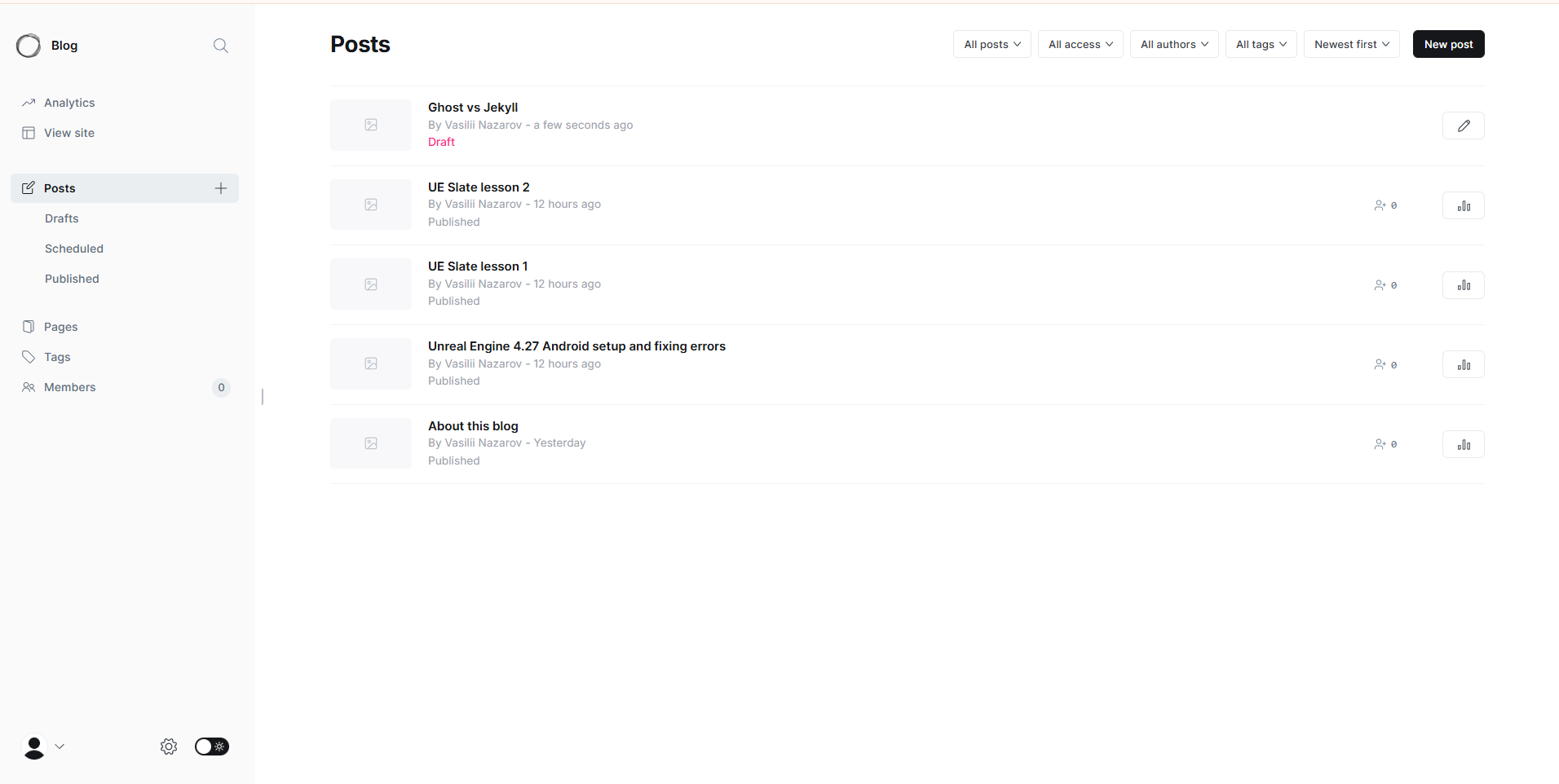
- It's convenient - no more manual editing! Ghost has an admin panel where you can configure almost everything.
- The page editor feels similar to Confluence - fewer features, but all essentials work as expected.
- Auto-saving for drafts.
- Easy to customize your site's design and add code highlighting.
#pragma once
#include "CoreMinimal.h"

class LEARNSLATE_API SMyWidget : public SCompoundWidget
{
public:
    SLATE_BEGIN_ARGS(SMyWidget) {}

    SLATE_END_ARGS()

    void Construct(const FArguments& InArgs);
};
Example code with highlighting
- And yes - the long-awaited image upload finally works perfectly.
- It's also much easier to connect Google Analytics.
I’ve shared my experience switching from Jekyll to Ghost.
This was both a test run and a small story about that process.
I hope it will be useful to someone - and motivate me to write more.